 CRATER ARCADE
Crater Arcade › Where’s your spleen? › Guide
Where is your spleen? Where 65 body parts are, and how to play
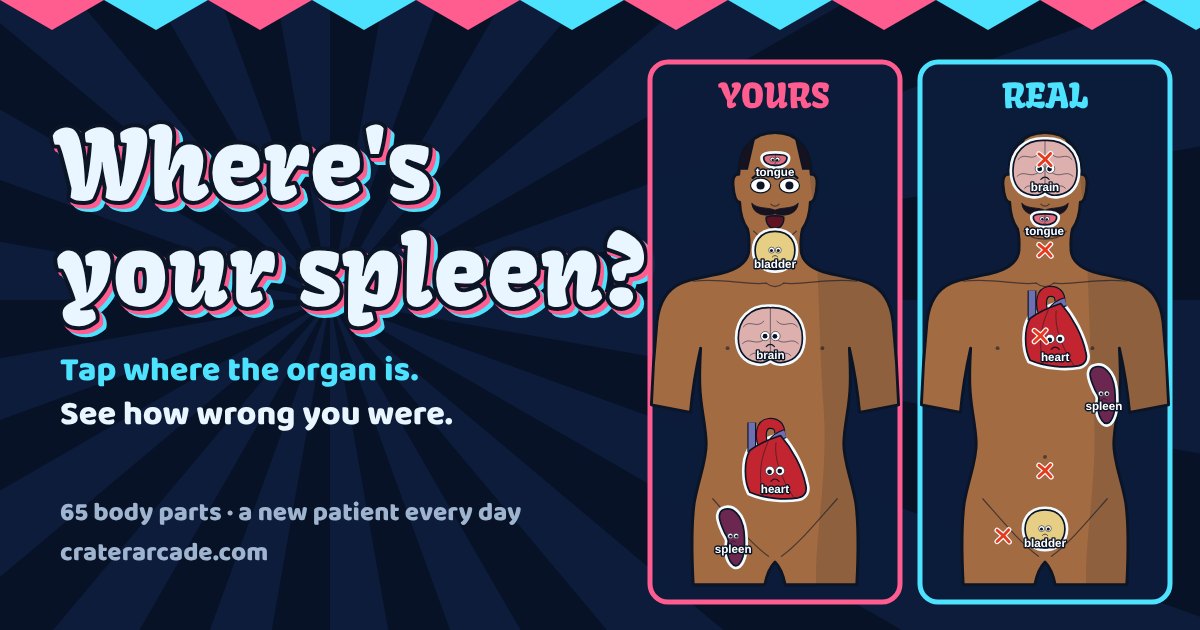
Most people point to the wrong place for their spleen, their kidneys and even their stomach. This page lists where 65 body parts really sit, in plain words, and explains how to play Where’s your spleen?, our free game that tests it.
How to play
You are the surgeon. Each patient needs you to find 5 body parts.
- Look at the map. You get 3 seconds to see where everything is inside the patient. Then it vanishes.
- Tap the spot. The game names a body part, such as the spleen. Tap or click where you think it is on the patient.
- Beat the fuse. A burning fuse is your time. You get 10 seconds for the first part, then 8, 6, 5 and 4. If it burns out, you score nothing for that part.
- See how wrong you were. The game shows the real place, how far off you were, and what you cut by mistake.
- Save the patient. Score 25 or more from the 5 parts and the patient walks out.
There is a new daily patient every day, the same for everyone, and you can play as many other patients as you like. From the second day you can also replay past daily patients for practice.
Controls
| You want to | Phone or tablet | Computer |
|---|---|---|
| Choose a spot | Tap the patient. For a careful aim, press, slide your finger, then lift. | Click the patient. Or move the crosshair with ← ↑ ↓ → (hold Shift for big steps) and press Enter or Space. |
| Move on after an answer | Tap Next organ, or tap anywhere. | Click, or press Enter. |
| Handle an emergency | Do what the screen says: tap fast, or tap on the beat. | Click, or press Space. |
| Sound and music | The round button in the top corner steps through sound and music, sound only, and all off. | |
Scoring and verdicts
Each body part scores up to 10 points. A tap inside the part scores the most, and the score drops by about a point for every centimetre you are away from it. Answering quickly adds a little. A timeout scores 0.
Double or Die is optional. From the second part of a patient you can press it once, before you aim. Land within 1 inch (2.5 cm) and that part’s points double. Miss and you lose 5.
If the heart monitor goes wild you get an emergency: charge the defibrillator by tapping fast, or do chest compressions on the beat. Saving the patient there adds bonus points.
| Total for the patient | Verdict |
|---|---|
| 55 or more | Cured. Chief of Everything. |
| 45 to 54 | Cured. Professor of Anatomy. |
| 38 to 44 | Cured. Attending surgeon. |
| 25 to 37 | Cured. Senior resident. |
| 15 to 24 | Deceased. Intern on a long shift. |
| Under 15 | Deceased. Please put the scalpel down. |
Your best score on one patient goes on the online high score table, under a name or nickname you choose.
Left and right
The patient faces you, like a person standing in front of you. So their left is on your right. The heart, the stomach and the spleen are on the patient’s left, which is the right-hand side of your screen. The liver, the gallbladder and the appendix are on the patient’s right, which is the left-hand side of your screen. Tapping the correct height on the wrong side is the most common mistake in the game.
Where each body part is
All 65 body parts in the game, grouped by area. “Left” and “right” always mean the person’s own left and right.
Head and face
| Body part | Where it is |
|---|---|
| Brain | A good start. It is about 2% of your weight and uses about 20% of your resting energy. |
| Cerebellum | Low at the back of the skull, about ear level. It coordinates balance and movement. |
| Pituitary gland | Pea-sized, at the base of the brain, behind the bridge of your nose. It directs the thyroid, adrenals and more. |
| Pineal gland | Rice-grain sized, deep in the middle of the brain. It releases melatonin when it gets dark. |
| Sinuses | Hollow spaces in the bones of the face: behind the forehead above the eyebrows, and in the cheeks beside the nose. Either side counts. |
| Cheekbone | Below the outer corner of each eye, running back towards the ear. Either side counts. |
| Eardrum | At the inner end of each ear canal, about an inch in from the opening. Either side counts. |
| Temple | The flat area at the side of the head, between the outer end of the eyebrow and the top of the ear. Either side counts. |
| Tear ducts | At the inner corner of each eye, beside the nose. Tears drain through them into the nose. Either side counts. |
| Tongue | In the floor of the mouth, anchored at the back to a small bone in the neck called the hyoid. |
| Jaw | The lower jawbone runs from the chin back to a hinge just in front of each ear. |
| Wisdom tooth | Right at the back of the jaw, so either side counts. Most people run out of room for them. |
| Uvula | The dangly bit at the back of your throat. It helps seal the nose off when you swallow. |
| Tonsils | Either side of the back of the throat, so either one counts. They catch germs on the way in. |
| Adenoids | High at the back of the nose, above the roof of the mouth, where the nose meets the throat. |
| Spit glands | The biggest pair sits in front of each ear, over the jaw. Smaller pairs sit under the jaw and under the tongue. Any of them counts. |
Neck and throat
| Body part | Where it is |
|---|---|
| Thyroid | Front of the neck, just below the Adam’s apple. This butterfly-shaped gland sets the pace of your metabolism. |
| Voice box | Behind the Adam’s apple, at the top of the windpipe. Air over the vocal cords makes your voice. |
| Windpipe | Down the front of the neck. It splits in two at about the level of the sternal angle. |
| Neck pulse | Either side of the windpipe, so either counts. Press beside the Adam’s apple to feel it pulse. |
| Jugular vein | Down each side of the neck, beside the neck pulse. It carries blood from the head back to the heart. Either side counts. |
| Esophagus | Down the middle, behind the windpipe and heart, then through the diaphragm into the stomach. About 10 inches. |
Chest
| Body part | Where it is |
|---|---|
| Heart | About two-thirds of it sits left of the midline, with the tip beating near the left nipple line. |
| Right lung | Three lobes on this side. The top of each lung rises above your collarbone. |
| Left lung | Only two lobes on this side. A notch in its front edge makes room for the heart. |
| Thymus | Behind the upper breastbone, just above the heart. It trains your T cells and shrinks after puberty. |
| Aorta | It arches over the heart and runs down just left of the midline, splitting near the navel. |
| Diaphragm | A dome of muscle under the lungs, higher on the right. It does most of your breathing. |
| Breastbone | Down the center of the chest. In CPR, the heel of your hand goes on its lower half. |
| Collarbone | From the top of the breastbone to the shoulder, either side. One of the most commonly broken bones. |
| Ribs | Twelve on each side, curving from the spine round to the front of the chest. Most of them join the breastbone. Any rib counts. |
| Floating rib | The lowest ribs, at the sides. They never reach the front of the body, so they float. |
| Pecs | The big chest muscles, from the breastbone and collarbone out to the top of each arm. Either side counts. |
| Shoulder blade | A flat triangle of bone on each side of the upper back, behind the ribs. The game shows it through the chest. Either side counts. |
| Vagus nerve | From the base of the skull down each side of the neck, beside the neck pulse and the jugular vein, then on through the chest to the belly. Either side counts. |
| Lymph nodes | In the hollow of each armpit. They swell up when they are busy fighting something. |
Shoulders and arms
| Body part | Where it is |
|---|---|
| Shoulder joint | Where the top of the arm bone meets the shoulder blade, at the outer end of the collarbone. Either side counts. |
| Biceps | The front of the upper arm, between the shoulder and the elbow. Either arm counts. |
| Funny bone | At the elbow, on the inner side towards the back. It is a nerve passing over the bone, not a bone at all. Either elbow counts. |
Belly
| Body part | Where it is |
|---|---|
| Liver | Tucked under your right ribs and reaching across the midline. At about 3 pounds, it is your largest internal organ. |
| Stomach | Higher than most people point. It sits under the left ribs, well above the navel, and is shaped like a J. |
| Spleen | Upper left abdomen, behind the stomach, under ribs 9 to 11. It filters old blood cells and fights infection. |
| Pancreas | Crosswise behind the stomach, head on the right, tail reaching for the spleen. It makes insulin and enzymes. |
| Gallbladder | Under the liver, where the right rib edge meets a line down from the nipple. It stores bile for digesting fat. |
| Left kidney | Higher than the "lower back" people point to, partly under the lowest ribs. It rides a little above the right one. |
| Right kidney | It sits slightly lower than the left kidney because the liver takes up the space above it. |
| Adrenal glands | A small cap on top of each kidney, so either one counts. They make cortisol and adrenaline. |
| Small intestine | Coiled around and below the navel. It runs for many feet and absorbs most of your nutrients. |
| Large intestine | It frames the small intestine: up your right side, across the middle and down your left. It mainly reclaims water. |
| Appendix | Lower right abdomen, a third of the way from the hip bone to the navel. Surgeons call this McBurney’s point. |
| Solar plexus | In the middle of the upper belly, just below the breastbone and behind the stomach. It is a knot of nerves. |
| Six-pack | The muscle down the front of the belly, from the lower ribs to the pubic bone, on both sides of the midline. |
| Love handles | The sides of the waist, just above the hip bones. Either side counts. |
| Spine | Down the middle of the back, from the base of the skull to the tailbone. The game shows it through the body. |
Pelvis and hips
| Body part | Where it is |
|---|---|
| Bladder | Low in the pelvis, behind the pubic bone. As it fills, it rises towards the navel. |
| Rectum | The last stop, low in the pelvis behind the bladder. |
| Uterus | If you have one: low in the middle of the pelvis, behind and above the bladder. |
| Ovaries | If you have them: low in the pelvis on each side, so either counts. |
| Fallopian tubes | If you have them: one from each side of the top of the uterus, reaching out to the ovary on that side. Either side counts. |
| Prostate | If you have one: walnut-sized, just below the bladder, wrapped around the urethra. |
| Hip bone | The wide curved bone at each side of the pelvis. You can feel its top edge just below your waist. Either side counts. |
| Hip joint | Deep in the groin crease on each side, where the ball at the top of the thigh bone sits in the pelvis. It is lower and further in than most people point. Either side counts. |
| Tailbone | The last few small bones at the very bottom of the spine, between the buttocks. |
| Sciatic nerve | From the lower spine through each buttock and down the back of the thigh. The game shows it from the front. Either side counts. |
| Thigh bone | From the hip joint down to the knee. It is the longest bone in the body. Either side counts. |
Tips
- Use the 3 seconds. Look at the belly first: the liver, stomach, spleen and kidneys are where most points are lost.
- Aim higher than you think. The stomach, the kidneys and the liver all sit under the lower ribs, well above the navel.
- Check the side. Say “their left, my right” before you tap anything that is on one side only.
- Don’t wait for a perfect aim. A quick tap that is close beats a slow one, and a timeout scores nothing.
- Save Double or Die for a part you really know, such as the brain or the bladder.
Questions
Where is your spleen?
Upper left abdomen, behind the stomach, under ribs 9 to 11. It filters old blood cells and fights infection. It is on the left side of the body, which is on your right when you look at the patient in the game.
Where is your appendix?
Lower right abdomen, a third of the way from the hip bone to the navel. Surgeons call this McBurney’s point.
Where is your liver?
Tucked under your right ribs and reaching across the midline. At about 3 pounds, it is your largest internal organ.
Is your heart on the left side?
About two-thirds of it sits left of the midline, with the tip beating near the left nipple line.
Where are your kidneys?
Higher than the "lower back" people point to, partly under the lowest ribs. It rides a little above the right one. It sits slightly lower than the left kidney because the liver takes up the space above it.
Where is your stomach?
Higher than most people point. It sits under the left ribs, well above the navel, and is shaped like a J.
Where is your pancreas?
Crosswise behind the stomach, head on the right, tail reaching for the spleen. It makes insulin and enzymes.
Is Where’s your spleen? free?
Yes. It is free to play in your browser on a phone, tablet or computer, with no download and no sign-up.
How many body parts are in the game?
There are 65. Each patient asks for 5 of them, and there is a new daily patient every day.
Is it suitable for children?
The jokes are about surgery going wrong, so we suggest it for ages 13 and up. The body part locations themselves are real anatomy.
Is this medical advice?
No. It is a game and a simple guide to where things are. Bodies vary, and pain is not always felt where the organ is. See a doctor about any health worry.
This page is a guide to a game, not medical advice.